// Blog post
Profitable Niches With Low Competition: Supplements for 2026

Table of Contents






Recent Posts
Popular posts
Certifications





Most supplement shelves are crowded. Multivitamins, whey protein and vitamin D all have hundreds of brands competing on price. The profitable niches with low competition in 2026 sit one step narrower: a specific buyer, a specific need, and a product built for both. This guide covers seven supplement niches with room for new brands, why each is growing, who buys, which formats suit it, and where the formulation and claims traps are.
Key Takeaways
- Low competition rarely means an empty category. It means a sharper buyer, a better format or a clearer formula than what is on the shelf now.
- Gut health, GLP-1 support, sleep, mood and stress, women's midlife health, targeted hydration and healthy aging all show clear demand signals for 2026.
- Format is often the opening. A gummy, powder or stick pack can stand out in a niche where every competitor sells the same capsule.
- Every niche has claim limits. Supplements can make structure/function claims only, and every claim needs evidence behind it.
What Low Competition Means for a Supplement Brand
A niche with low competition is not one nobody sells into. It is one where the current products leave a gap. You can see the gap in three places:
- Search results. Search the niche on Amazon and Google. If the first page is full of the same formula in the same format, a different format or dose is an opening.
- Reviews. Read the three-star reviews of the top sellers. Complaints about taste, pill size, sugar or "too many ingredients" tell you what to build.
- The buyer. Broad products speak to everyone. A product for a named group, such as women over 45, night-shift workers or endurance runners, faces far fewer direct rivals.
Survey data helps show where interest is moving. The 2024 CRN Consumer Survey on Dietary Supplements found that 75% of Americans use supplements. Among supplement users, magnesium use rose from 19% in 2023 to 23% in 2024, prebiotic use rose from 5% to 7%, and ashwagandha reached 8%, up from 2% in 2020. Those shifts point to several of the niches below.
7 Profitable Supplement Niches With Low Competition in 2026
1. Gut Health Beyond Probiotics
Why it is growing: Probiotic capsules are crowded, but buyers now look for prebiotics, fiber blends and digestive enzymes. The CRN data above shows prebiotic use rising.
Who buys: Adults who want regularity and digestive comfort, and people who already take a probiotic and want a next step.
Formats that suit it: Powders and stick packs for fiber, since a useful fiber dose is too large for a capsule or gummy. Capsules for enzymes.
Cautions: Live probiotic counts drop over shelf life, so label claims must hold to the expiry date, not just at manufacture. Keep claims to digestive function, such as "supports regularity", never to digestive disease.
2. GLP-1 Support Nutrition
Why it is growing: More people now use GLP-1 medications for weight management. Many eat less, and they look for help getting enough protein, fiber, fluids and micronutrients.
Who buys: Adults on or coming off these medications, often guided by a clinician or a telehealth program.
Formats that suit it: Protein powders, fiber stick packs, electrolyte mixes and a complete multivitamin in a capsule or tablet.
Cautions: This is the niche with the most risk. Do not name a drug on the label, do not imply the product mimics or replaces a medication, and do not promise weight loss. Position the product as nutrition support, for example "helps you meet daily protein needs".
3. Sleep Without the Single-Ingredient Pill
Why it is growing: Melatonin tablets fill the shelf. Buyers increasingly want non-melatonin or low-dose options built around magnesium, L-theanine, glycine or herbal extracts. CRN reports magnesium and melatonin use both rising among supplement users.
Who buys: Adults with busy schedules, shift workers and people who prefer to avoid melatonin.
Formats that suit it: Gummies for a nightly ritual, powders for a warm evening drink, capsules for higher magnesium doses.
Cautions: Magnesium is bulky, so a gummy cannot carry a large dose. Choose the magnesium form with care, since forms differ in tolerance. Use claims such as "supports restful sleep", never claims about insomnia.
4. Mood and Stress Support
Why it is growing: Adaptogens moved from specialty stores to mainstream shelves. Ashwagandha's rise in the CRN data is one signal.
Who buys: Working adults, students and parents looking for help with occasional stress and a calm mood.
Formats that suit it: Capsules for standardized extracts, gummies for daily routines, powders for functional drinks.
Cautions: Use standardized extracts at the doses used in published studies. Say "supports a calm mood" or "helps with occasional stress", never anything about anxiety or depression.
5. Women's Midlife and Menopause Support
Why it is growing: Women in midlife are asking for products built for their stage of life, and many general women's formulas still target younger buyers.
Who buys: Women from their early 40s through their 60s.
Formats that suit it: Capsules for botanical blends, gummies for easy daily use, powders that pair collagen or protein with key nutrients.
Cautions: Claims must stay with normal life stages, such as "supports comfort during menopause". Some botanicals have known safety questions, so check each ingredient before you commit to it.
6. Targeted Hydration
Why it is growing: Electrolyte mixes are popular, but many are high in sugar or built for a single use. Brands are finding space with low-sugar, sugar-free, kids' and specific-activity formulas.
Who buys: Athletes, outdoor workers, travelers and people on low-carb diets.
Formats that suit it: Stick packs for single servings, tubs for home use.
Cautions: Taste decides repeat purchase in this niche. Plan for several flavor rounds before you lock the formula. Keep claims to hydration and electrolyte balance.
7. Healthy Aging and Mobility
Why it is growing: Adults over 50 want to stay active. Creatine, once sold mostly to young lifters, is now marketed to older adults and to women, alongside collagen and joint formulas.
Who buys: Active adults over 50 and the adult children who shop for them.
Formats that suit it: Powders for creatine and collagen, capsules and tablets for joint formulas, gummies for people who dislike pills.
Cautions: Creatine and collagen doses are measured in grams, so gummies need honest serving sizes. Say "supports joint comfort" or "supports muscle strength with exercise", never claims about arthritis.
How to Choose the Right Niche for Your Brand
A niche is only profitable if you can reach its buyers and keep them. Check each option against these questions:
- Can you reach the buyer? A niche tied to a community you already know is easier to sell into than one you have to learn from scratch.
- Is there a reason to reorder? Daily-use products such as fiber, sleep and hydration drive repeat sales. One-off products do not.
- What will you charge? Price your product against the top three sellers and work back to a unit cost that leaves room for marketing.
- Can you support the claim? If the evidence for your main ingredient is thin, the claim you can make will be weak.
- Can you test small? Start with a run size you can sell through, then scale what works.
Claims and Compliance Across Every Niche
Dietary supplements in the US can make structure/function claims, such as "supports healthy digestion". They cannot claim to diagnose, treat, cure or prevent a disease. When you use a structure/function claim, the FDA requires a label disclaimer and a notification to the agency within 30 days of marketing the product. The FTC also expects advertising claims to be backed by competent and reliable scientific evidence. Build your claims around the research on your ingredients and doses, and keep that file on hand.
How F.A.M.E. Health Labs Helps You Launch in a Niche
We are a B2B supplement manufacturer on a single campus in Cedartown, Georgia. Our facility is FDA-registered and operates to cGMP, with SQF, NSF, MOSA Certified Organic, Halal and Kosher certifications.
- Test a niche with stock formulas. Our 800+ F.A.M.E.-owned stock formulas cover gut health, sleep, stress, women's health, hydration, joints and more. Stock runs start from 500 units.
- Build a custom formula when you need a different dose, ingredient or flavor. Custom runs start from 2,500 units.
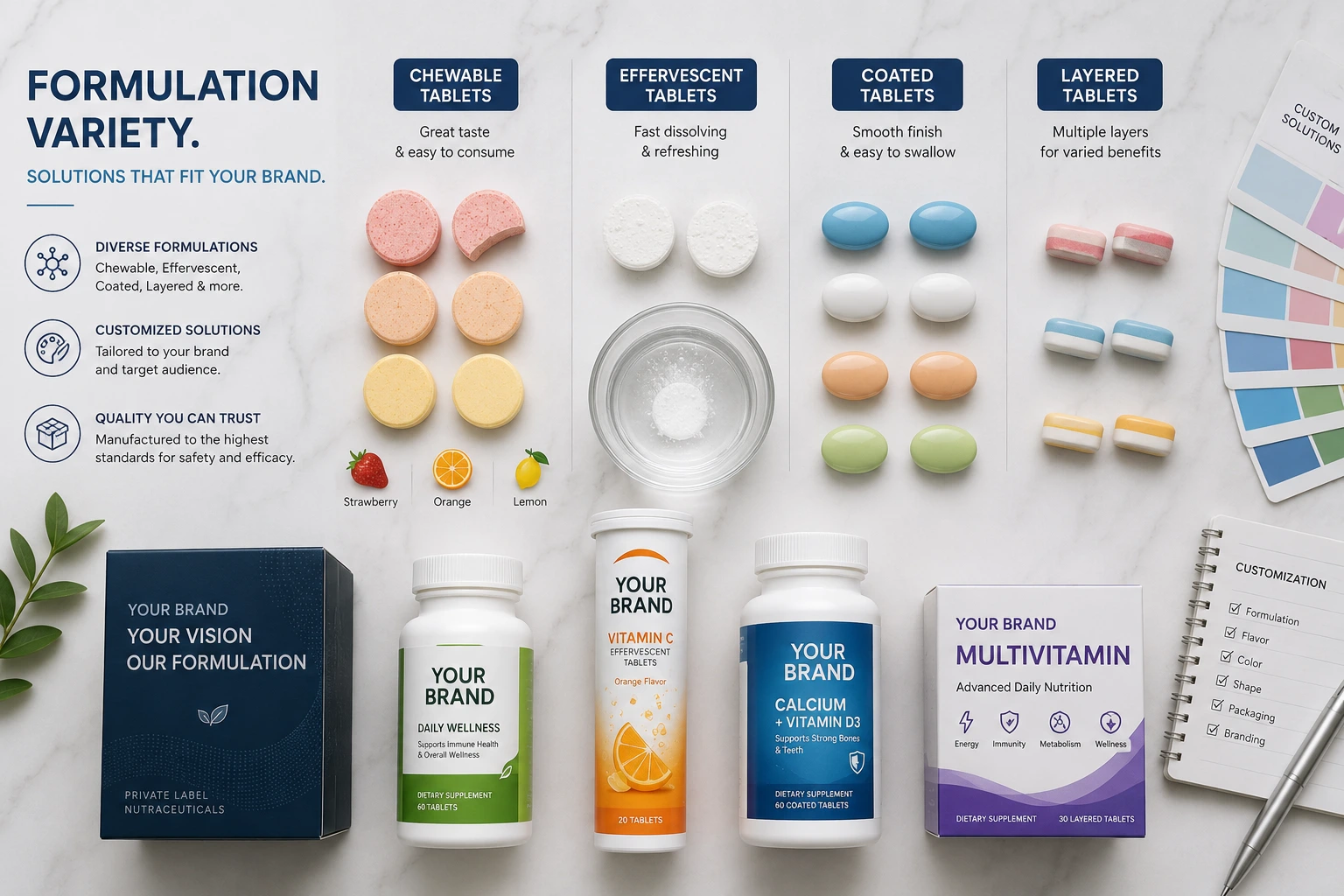
- Pick the format your niche needs. We manufacture capsules, tablets, powders, gummies and liquids in-house, plus stick packs and sachets. Softgels are produced through a specialist partner.
- Check quality before launch. CURI, our sister lab on the same campus, is ISO 17025 accredited and tests raw materials and finished products, and can track probiotic counts across shelf life.
- Get label and packaging design support as part of your program.
Have a niche in mind? Request a quote and our team will match it to a stock formula or scope a custom one.
FAQs
What are the most profitable supplement niches with low competition in 2026?
Strong candidates include gut health beyond probiotics, GLP-1 support nutrition, non-melatonin sleep formulas, mood and stress support, women's midlife health, targeted hydration, and healthy aging and mobility. Each has growing demand and room for a sharper product or format.
How do I know if a supplement niche has low competition?
Search the niche on Amazon and Google, then study the top sellers. If they all use the same formula and format, or their reviews repeat the same complaints about taste, pill size or sugar, there is room for a better product.
Can a GLP-1 support supplement claim to help with weight loss?
No. Do not name a drug, imply the product works like a medication, or promise weight loss. Position it as nutrition support, such as helping people meet daily protein or fiber needs, and back every claim with evidence.
What is the minimum order to test a new supplement niche?
At F.A.M.E. Health Labs, stock formulas start from 500 units and custom formulas start from 2,500 units. Many brands test a niche with a stock formula first, then move to a custom formula once demand is proven.
Which supplement format works best for a niche product?
It depends on the dose and the buyer. Powders and stick packs suit gram-level doses such as fiber, creatine and electrolytes. Capsules suit concentrated extracts. Gummies suit daily routines with smaller doses.
// Our Services
What Do You Need?
Select the service that matches your need. Each card expands to show what's included, minimum orders, and certifications then routes you directly to the right section of the form below.

F.A.M.E. Health Labs
Contract Manufacturing
Full-service supplement manufacturing from stock to custom white label, private label, co-manufacturing, and bulk.
See Services






F.A.M.E. Ingredients
Ingredient Sourcing
Global raw material sourcing, proprietary blend development, MOSA Organic, Halal and Kosher flavor systems.
See Services


Curí Inc.
Testing & CRO
ISO/IEC 17025 accredited testing ingredient and finished product. COAs accepted globally by FDA, Health Canada, and EU.
See Services



F.A.M.E. Complete
Enterprise Partnership
Full-platform commercial partnership for high-volume brands. Dedicated team, VP-level account management, real-time portal.
See Services