// Blog post
Types of Tablets: Choose the Right Form for Your Supplement Brand
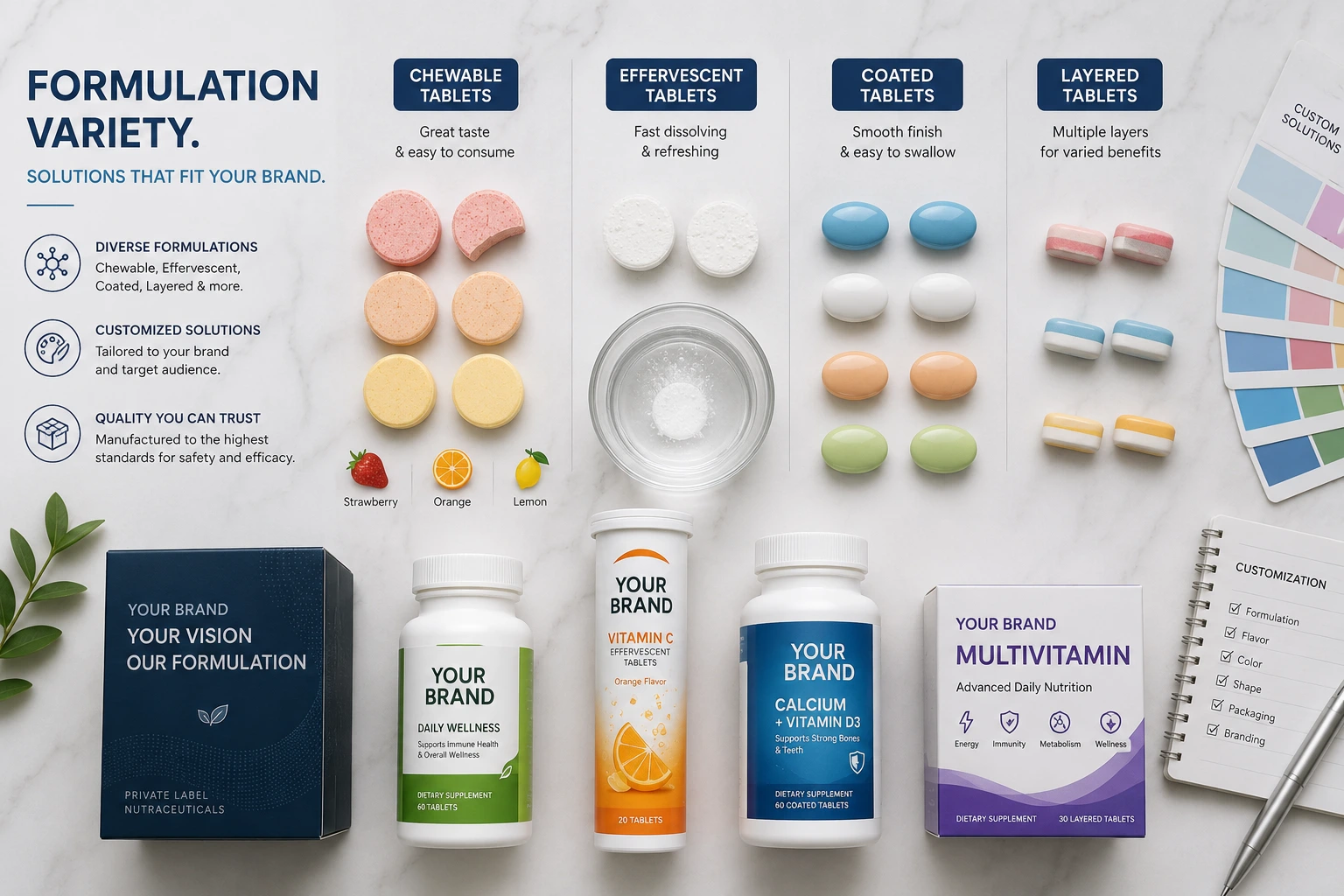
Table of Contents






Recent Posts
Popular posts
Certifications





Not every tablet works the same way. For brands partnering with a supplement manufacturer, the tablet type chosen early in development shapes everything downstream: absorption rates, consumer experience, and regulatory fitness. It is worth making that decision deliberately.
What Are Tablets and Why the Type You Choose Matters
A tablet is a solid dosage form made by compressing active ingredients with excipients into a uniform shape. In pharmaceutical and supplement manufacturing, tablets are valued for consistency, stability and scalability. The wrong tablet type creates problems that are hard to undo. Depending on the formulation, tablet type can affect:
- Bioavailability: How efficiently the body absorbs the active ingredient.
- Onset time: How quickly effective levels reach the bloodstream.
- Shelf stability: How the product holds up against heat, moisture, and time.
- Target audience fit: Children, elderly consumers and active adults all have different needs.
- Regulatory alignment: Formulations must meet FDA dietary supplement regulations and cGMP requirements in the US, and local food supplement rules in any other market you sell into.
Types of Tablets Used in the Supplement Industry
Below are the nine tablet types most used in supplement manufacturing today:
1. Compressed Tablets
The baseline. Active ingredients are mixed with binders and fillers, then pressed under controlled force. This form is practical, cost-efficient at volume, and consistent in dose accuracy.
2. Coated Tablets
A film or sugar layer covers the compressed core. It masks unpleasant taste, shields ingredients from moisture and light, and makes the tablet easier to swallow.
3. Enteric-Coated Tablets
The coating resists stomach acid, so dissolution occurs only in the small intestine. This suits pH-sensitive ingredients like certain enzymes or probiotic strains, and compounds that cause gastric irritation when released too early.
4. Chewable Tablets
Formulated to be chewed before swallowing, these do not require water. Flavoring agents are included for palatability. Multivitamins and calcium supplements commonly use this form.
5. Effervescent Tablets
Dissolved in water before consumption, these create a drinkable solution. This improves taste and can help with absorption for certain ingredients. You'll find them in electrolyte and vitamin C products. Note: we do not manufacture effervescent tablets. For drink-mix formats we offer powders and stick packs.
6. Sublingual Tablets
Placed under the tongue, these dissolve through the mucous membrane, bypassing the digestive tract. Active ingredients can reach the bloodstream faster than with conventional oral tablets.
7. Dispersible Tablets
Broken down in a small volume of water before ingestion. For consumers who struggle to swallow solid forms, including many pediatric and older adult users, this format removes that barrier.
8. Extended-Release Tablets
These deliver active ingredients gradually across several hours rather than all at once. Dosing frequency decreases, and ingredient levels in the bloodstream stay more consistent.
9. Multi-Layer Tablets
Two or more compressed layers occupy a single tablet, each carrying different ingredients or release functions. Useful when compounds would interact if combined, or when staggered delivery is the goal.
How Tablet Type Affects Supplement Performance
Tablet format has measurable effects on how well a product works in real life.
- Absorption speed: Sublingual and effervescent forms can act faster than standard compressed tablets
- Ingredient protection: Enteric coatings offer more targeted acid shielding than conventional film coats
- Consumer compliance: Chewable and dispersible formats are often easier for children and older adults to take consistently
- Formula compatibility: Compounds that react when combined may only be viable in a multi-layer configuration
- Dosing precision: Generally strong across all tablet forms, though extended-release types require more rigorous pre-launch validation
Tablet Manufacturing Considerations: What You Should Know
The manufacturing process introduces technical and compliance requirements that brands benefit from understanding before production starts.
- cGMP compliance is a baseline requirement under FDA regulations for supplements sold in the US.
- Excipient selection (binders, disintegrants, and lubricants) directly affects hardness, dissolution behavior, and long-term stability.
- Compression calibration prevents defects, including capping, lamination, and inconsistent tablet weight.
- In-process testing across hardness, friability, disintegration, and weight uniformity must happen at each production stage.
- Stability data informs decisions around packaging for supplements, from moisture-barrier bottles to blister configurations and desiccant use.
- A tablet manufacturer with NSF-certified GMP status will have documented protocols for each of these variables in place before a run begins.
Industry Trends and Innovations in Tablet Formulation
Several shifts are influencing how brands and manufacturers approach tablet format choices.
- Clean-label priorities are pushing formulators toward natural coatings and plant-derived excipients.
- Multi-layer tablets are attracting attention as brands look to deliver time-differentiated nutrient release in one product.
- Halal and Kosher certification in tablet formulations has become a standard expectation for brands with international distribution.
- Certified organic manufacturing is often a requirement for brands selling into the natural products channel.
- Lower minimum order quantities at compliant facilities let early-stage brands test formats before committing to full production runs.
The Right Tablet Type Builds a Stronger Supplement Brand
Brands that understand the importance of tablet format before committing to a formulation path tend to move through development with fewer setbacks. That is the kind of groundwork F.A.M.E. Health Labs is built to support. As an FDA-registered, NSF cGMP-certified, and SQF-certified contract manufacturer, we manufacture tablets in-house and work with supplement brands from format selection through finished product. Choosing a supplement manufacturer is a big decision, so settle tablet format with them early.
Frequently Asked Questions (FAQs)
Q.1. What are the different types of tablets?
The main types of tablets in supplement manufacturing are compressed, coated, enteric-coated, chewable, effervescent, sublingual, dispersible, extended-release and multi-layer. Each addresses a specific delivery, stability, or consumer usability need.
Q.2. Which type of tablet is best for supplements?
No universal answer exists. Selection depends on the active ingredient, intended consumer, and compliance standards. Compressed and coated tablets dominate supplement production; extended-release and enteric-coated forms are used when protection or sustained delivery is the priority.
Q.3. What is the difference between coated and uncoated tablets?
Uncoated tablets have no outer layer and break down quickly in the stomach. Coated tablets carry a film or enteric coating controlling where dissolution occurs, while also protecting against moisture and improving taste.
Q.4. Which tablet type is best for children?
Chewable and dispersible tablets are the standard choice for pediatric use. Neither requires swallowing a whole tablet, both reduce choking risk, and both can be flavored for acceptance.
Q.5. How do I choose the right tablet type for my brand?
Start at the ingredient level and consider its pH or acid-protection needs. You also have to consider who the consumer is and their usage context. Think about your manufacturer's format capabilities, market-specific regulations and stability data.
Q.6. Can the tablet type influence shelf life and stability?
Yes. Coated tablets hold up better against environmental factors than uncoated forms. Enteric coatings offer additional protection for sensitive compounds. Stability testing and appropriate packaging are always required to support any shelf life claim.
// Our Services
What Do You Need?
Select the service that matches your need. Each card expands to show what's included, minimum orders, and certifications then routes you directly to the right section of the form below.

F.A.M.E. Health Labs
Contract Manufacturing
Full-service supplement manufacturing from stock to custom white label, private label, co-manufacturing, and bulk.
See Services






F.A.M.E. Ingredients
Ingredient Sourcing
Global raw material sourcing, proprietary blend development, MOSA Organic, Halal and Kosher flavor systems.
See Services

Curí Inc.
Testing & CRO
ISO/IEC 17025 accredited testing ingredient and finished product. COAs accepted globally by FDA, Health Canada, and EU.
See Services



F.A.M.E. Complete
Enterprise Partnership
Full-platform commercial partnership for high-volume brands. Dedicated team, VP-level account management, real-time portal.
See Services