// Blog post
Capsule Size Chart: How to Choose the Right Size for Your Brand
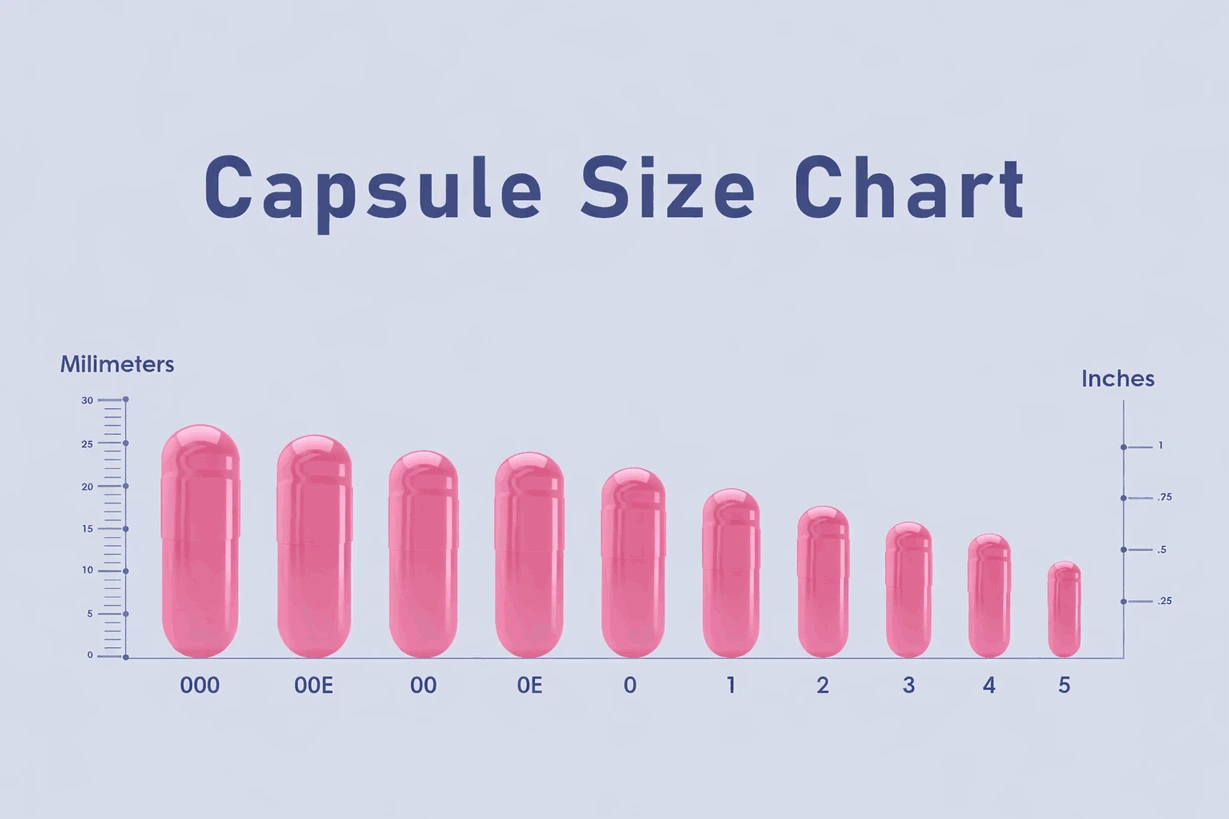
Table of Contents






Recent Posts
Popular posts
Certifications









The US supplement market is large and crowded, so brands need clear ways to stand out. High-quality ingredients are only half the job. The delivery format also shapes how consumers feel about a product. This is why a detailed capsule size chart is a basic tool for any capsule brand.
Selecting the correct shell size impacts dosage accuracy and ease of swallowing. These factors directly influence customer reviews and brand loyalty in markets like the UK and the USA. A good chart links your blend density to shell capacity, so production decisions rest on data rather than guesses. The right size also makes the daily routine easy, which is what consumers expect.
Understanding Capsule Sizes
Capsule sizing looks simple until you try to fit a real blend. The industry uses a numerical scale to categorise shells, with the numbers running in reverse order of size.
Common Capsule Sizes
Small capsule sizes, such as 5, 4, and 3, are suitable for low-dose formulas and many children’s products. Mid sizes such as 2 and 1 fit many everyday supplements. Larger sizes, such as 0, 00, and 000, fit bulky powders or higher serving weights, and a size chart helps you compare them quickly.
Standard Capsule Volume and Dosage
Each number on the capsule size chart corresponds to a specific internal volume measured in milliliters. For example, a size 000 capsule has a volume of approximately 1.37 milliliters. A size 0 capsule offers 0.68 milliliters of space. Understanding these volumes is the only way to accurately calculate your dosage. You cannot simply look at milligrams, because different powders have different weights per volume.
Why Capsule Size Matters for Your Supplement Brand
The physical sizes of capsules of your supplement are a direct reflection of your brand identity and your commitment to the user experience.
Consumer Preference
Remember, everyone wants a routine that feels easy. If the capsule feels too large, they may skip doses, which may lead to quitting. For example, a consumer might take supplements quickly with a small water bottle before work. A capsule size chart helps you choose a size that fits your situation.
Dosage Precision
Precision is the foundation of a successful supplement brand. If your capsule is too large for the required dose, you will have empty headspace inside the shell. Customers will notice if capsules leak powder or are filled to the brim. Both of these issues can lead to returns and negative reviews.
Key Factors to Consider When Choosing Capsule Size
Every formulation has unique characteristics that dictate the physical space it requires.
Product Type and Ingredients
The physical state of your ingredients is the first thing to evaluate. Oil-based supplements usually go into softgels, while most powders and granules suit two-piece hard shells. If you are using a hygroscopic ingredient that absorbs moisture, you might need a specific material, such as HPMC. These materials are available in all sizes listed on a standard capsule size chart.
Manufacturing Costs
The capsule sizes affect line speed, waste, and packaging. It can also change bottle size, which changes freight for direct-to-consumer shipments in both markets.
Smaller sizes can require more units per serving. Larger sizes can cost more per unit and reduce flexibility on some lines. Capsule manufacturer selection can affect shell tolerances and the stability of weights across lots.
You should use the capsule size chart to track capsules per serving, capsule cost, and packaging impact in one place.
Shelf Life
The amount of air trapped inside a capsule can affect the stability of your ingredients. If there is too much empty space, oxygen can degrade sensitive vitamins or oils. By selecting the tightest possible fit using a capsule size chart, you minimize the oxygen exposure of your formula. This helps maintain the potency of your product throughout its shelf life.
How Capsule Size Impacts Branding and Marketability
Visual cues tell a story about your product quality and its intended use.
Visual Appeal
The appearance of your capsule in the bottle creates an immediate impression. Smaller capsules often read as approachable. Larger capsules can be read as high doses and intense. Clear shells can highlight botanical texture. Opaque shells can look more clinical.
Market Differentiation
Standing out in the supplement aisle requires unique selling points. Serving count is a selling point in many categories. If your product meets the dose in fewer capsules, that is easy for shoppers to grasp.
Market research firms expect the two-piece hard capsule market to keep growing over the next decade, and size 0 remains one of the most widely used sizes.
Which Size Works for Different Types of Supplements?
Different categories of health products have established norms based on traditional dosing needs.
| Capsule Size | Volume (ml) | Typical Weight Capacity (0.8 g/ml density) | Common Uses |
|---|---|---|---|
| 000 | 1.37 | 1096 mg | Sports nutrition, high-dose amino acids |
| 00 | 0.91 | 728 mg | Multivitamins, herbal blends, minerals |
| 0 | 0.68 | 544 mg | Probiotics, single vitamins, antioxidants |
| 1 | 0.50 | 400 mg | Concentrated extracts, brain health |
| 2 | 0.37 | 296 mg | Pediatric, geriatric, or high-potency |
| 3 | 0.30 | 240 mg | Low-dose actives, small serving sizes |
Herbal and Plant-Based Supplements
Herbal powders are often fibrous and have a low density. This means you usually need a larger size, such as 00 or 000, to achieve a clinically relevant dose. You should record each blend’s packing range in your capsule size chart to stay predictable.
High Potency Vitamins and Minerals
Minerals often pack densely, so size 1 or 0 can work well. Validate with a pilot run to confirm the fill range. Using a capsule size chart helps you choose a size that looks appropriate for the dose.
Protein and Weight Management Supplements
Protein and weight-loss formulas often contain multiple ingredients, such as caffeine, green tea extract, and fiber. These complex blends usually require a size 00 capsule to accommodate everything in a single serving.
Weight management brands often use a capsule size chart to fit the full serving into fewer capsules. That reduces the number of capsules needed per day.
Children’s Supplements
Safety, comfort, and parent confidence are the most important factors for pediatric products. Size 3 or size 4 capsules are easier for older children who are learning to swallow pills.
Children’s supplements, like all supplements, can carry structure/function claims only. A capsule size chart helps you find the smallest size that still holds the dose.
Common Mistakes to Avoid When Choosing Capsule Sizes
Most sizing mistakes come from skipping tests or rushing label work. Use this short list as a final check alongside your capsule size chart.
- Avoid Imitation: Do not choose a size because a competitor uses the size.
- Label Later: Do not write the label first, so that you do not have to force the fill to match the label.
- Early Testing: Do not skip flow testing or leave weight checks until late.
- Consider Logistics: Do not ignore the packaging and shipping impact.
- User Feedback: Do not skip the swallow test with target users.
Make Capsule Sizing a Brand Advantage
The road to a successful supplement brand is paved with small, technical decisions that have a large impact. Capsule size is one of them. By using a capsule size chart, you take control of your product quality, consumer satisfaction, and manufacturing costs. It is the bridge between a great formula and a finished product that your consumers will love.
Precise sizing still needs a manufacturer with regulatory and production experience behind it. F.A.M.E. Health Labs manufactures capsules in-house at our FDA-registered, cGMP facility in Cedartown, Georgia. We handle everything from custom formulation (from 2,500 units) or one of our 400+ stock formulas (from 1,000 units) to a finished, labeled product, including capsule size and shell selection.
FAQs
What are the standard capsule sizes?
The standard lineup is 000, 00, 0, 1, 2, 3, 4, and 5. Use a capsule size chart to compare volume and typical use.
What capsule size is easiest to swallow?
Smaller sizes like 3, 4, and 2 often feel easier for many people. The best answer comes from testing with a pilot audience.
How do I choose the right capsule size for my product?
Set a target dose per serving, then measure blend density. Run pilot fills in two candidate sizes and weigh the capsules to check consistency. Update your capsule size chart with the tested range and serving count.
Do larger capsules mean higher doses of ingredients?
Larger shells can hold more volume, yet the dose depends on ingredient density. Use your capsule size chart to compare capacities, then confirm with fill-weight testing.
How can I make my supplement capsules more appealing to consumers?
Keep the routine simple and the capsule comfortable. Use consistent colors and clean visuals that match your brand story.
Are there vegan options for capsule sizes?
Yes. HPMC and pullulan shells are popular vegan alternatives to traditional gelatin. These plant-based options are available in all the standard dimensions found on a capsule size chart.
// Our Services
What Do You Need?
Select the service that matches your need. Each card expands to show what's included, minimum orders, and certifications then routes you directly to the right section of the form below.

F.A.M.E. Health Labs
Contract Manufacturing
Full-service supplement manufacturing from stock to custom white label, private label, co-manufacturing, and bulk.
See Services







F.A.M.E. Ingredients
Ingredient Sourcing
Global raw material sourcing, proprietary blend development, MOSA Organic, Halal and Kosher flavor systems.
See Services


Curí Inc.
Testing & CRO
ISO/IEC 17025 accredited testing ingredient and finished product. COAs accepted globally by FDA, Health Canada, and EU.
See Services

F.A.M.E. Complete
Enterprise Partnership
Full-platform commercial partnership for high-volume brands. Dedicated team, VP-level account management, real-time portal.
See Services