Choosing Between Collagen Capsules vs Powder for Private Label Supplements
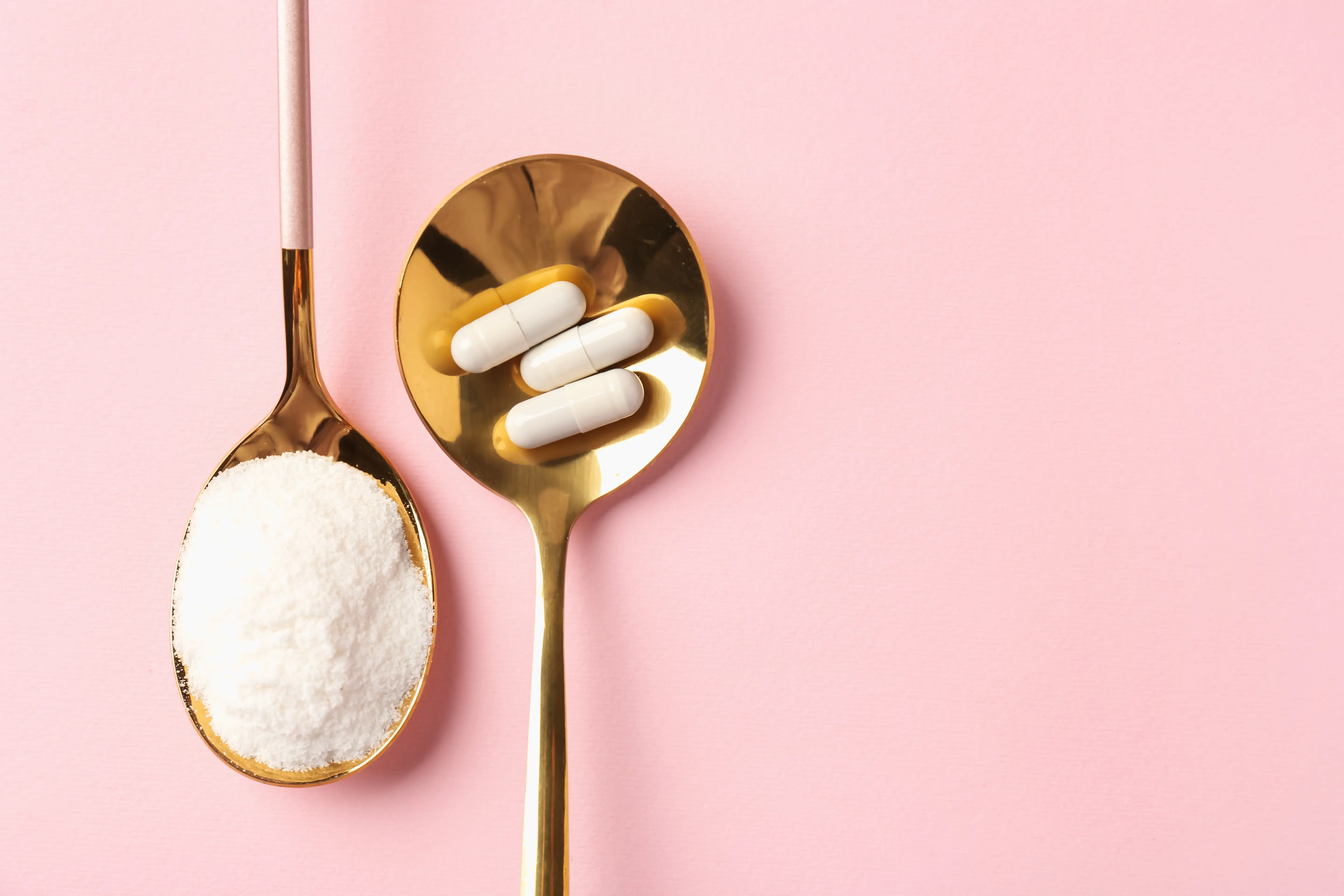
Table of Contents





Recent Posts
Popular posts
Certifications





The collagen market isn't just growing; it’s evolving. A few years ago, putting "Collagen" on a label was enough to move units. Today, customers are sophisticated and well-informed. They care about solubility, "pill burden," and the sensory experience of their supplements.
At F.A.M.E. Health Labs, we find that the most successful brand launches aren't the ones with the biggest marketing budgets—they’re the ones that choose the right delivery format for their specific audience. This guide is designed to help you navigate the high-stakes decision between collagen capsules vs powder from a manufacturing and business perspective.
Understanding Collagen Supplements: The Bulk Ingredient Challenge
To understand why the format matters, it is important to analyze the ingredient itself. Collagen is a structural protein. It is usually taken in multi-gram servings, unlike ingredients such as vitamin D or caffeine that work at much smaller doses.
A standard intake range for skin elasticity or joint support typically ranges from 5g to 20g per day. This "bulk" nature of the ingredient is the primary driver of the collagen powder vs capsules debate. At F.A.M.E. Health Labs, we help brands package that volume in a way that ensures customers consistently take it every day.
Why Format Selection Matters for Private Label Brands
When you partner with a collagen supplement manufacturing expert like F.A.M.E. Health Labs, the format selection becomes a strategic decision. It dictates your:
- Cost of Goods Sold (COGS): Capsules require more quality checks and machinery time.
- Shipping & Fulfillment: Tubs of powder take up more warehouse "cube" than bottles of capsules.
- Customer Retention: Powder becomes a "food habit" (like coffee); capsules become a "health habit" (like medicine).
Collagen Capsules vs Powder: Key Differences
While both formats ultimately deliver the same bioactive peptides, the consumer experience and the manufacturing backend are worlds apart. As a brand owner, you aren't just choosing a container; you are choosing the dosage threshold and the sensory profile of your brand.
1. Collagen Content per Serving
This is the most significant hurdle in the collagen capsules vs powder debate. The math of encapsulation is unforgiving. A standard "00" capsule, which is the industry workhorse at F.A.M.E. Health Labs, typically holds about 500mg to 750mg of material. If your marketing hinges on providing a 10g clinical dose of collagen, a customer would need to swallow between 14 and 20 capsules every single day.
For many consumers, "pill fatigue" is a real barrier to entry. This is why powder is the undisputed king of high-dose delivery. A single 10g or 20g scoop in a powder jar provides a "macro-dose" that capsules simply can't match without becoming a chore for the user.
However, at F.A.M.E. Health Labs, we see a strategic opening for capsules in the "Beauty & Glow" sector. If you aren't aiming for 20g of protein and instead want to offer a concentrated blend of collagen, Biotin, and Vitamin C, a 2-capsule serving becomes a highly convenient and marketable "beauty ritual."
2. Absorption & Effectiveness
There is a common industry myth that one format is inherently "more absorbable" than the other. The reality we see in our lab is that once the collagen has been hydrolyzed into peptides, a process we prioritize at F.A.M.E. Health Labs, the body recognizes it the same way regardless of the carrier.
- Powder: Since it’s typically dissolved in a liquid (like coffee or a smoothie) before ingestion, it is essentially "pre-dissolved." This can lead to slightly faster initial absorption in the small intestine.
- Capsules: These require an extra 5–10 minutes for the stomach acid to break down the gelatin or veggie shell. Once that shell is gone, the absorption rate levels out.
3. Taste, Flavoring & Customization
If you go the powder route, you are entering the world of sensory branding. At F.A.M.E. Health Labs, we’ve mastered the art of masking the natural, sometimes "earthy" notes of bovine collagen and the slight "oceanic" scent of marine peptides.
- Powder Customization: We offer an extensive library of Stock Flavors from classic Vanilla and Rich Chocolate to more exotic profiles like Mango Peach or Tropical Bliss. Flavoring is your strongest tool for customer retention.
- Capsule Neutrality: Capsules are the perfect "escape hatch" for brands that want to avoid the R&D time of flavoring. Since the powder is sealed in a shell, the taste is completely neutralized. This is especially beneficial for high-purity marine collagen lines where even the best flavoring might not fully mask the scent for "super-taster" customers.
4. Cost & Value
From a collagen supplement manufacturing standpoint, the cost structure of these two formats varies significantly based on your "Price Per Gram" strategy.
- Manufacturing Complexity: Encapsulation is a precision-heavy process. It requires more machine time and labor per gram of active ingredient compared to high-speed powder filling. Therefore, capsules often have a higher COGS (Cost of Goods Sold) relative to the amount of collagen provided.
- Consumer Perception: While powder is cheaper to produce in bulk, it also carries higher shipping and storage costs due to the size and weight of the tubs. Capsules, being compact and light, offer a distinct advantage in fulfillment and Amazon FBA fees.
- Market Positioning: Customers are often willing to pay a premium for the convenience of capsules, even if the total collagen count is lower. At F.A.M.E. Health Labs, we help you calculate the "Sweet Spot"—where your production costs, shipping fees, and retail MSRP align to give you the healthiest margins in the industry.
Deep Dive: Collagen Capsule Benefits
If powder leads in dosage, capsules lead in convenience. There is a massive segment of the market busy professionals, frequent travelers, and "pill-minimalists" who simply won't mess with scoops and shakers.
Reducing the "Pill Burden"
The challenge with capsules is the math. A standard "00" size capsule holds about 500mg to 750mg of collagen. To get a 10g dose, a customer would need to swallow 15 to 20 capsules.
However, we specialize in "Collagen Plus" formulations. Instead of trying to provide 20g of collagen in a pill, we help brands create targeted beauty capsules. By combining 2g of high-quality collagen with Biotin, Hyaluronic Acid, and Vitamin C, you can offer a "Beauty Complex" that fits into 3 or 4 capsules. This changes the positioning from "protein replacement" to "skin-glow precision."
Manufacturing Precision as a Capsule Manufacturer
When you work with F.A.M.E. Health Labs as your Capsule Manufacturer, you’re getting more than just a filled shell. We use high-speed encapsulation technology that ensures weight uniformity. If your label says 750mg, our machines ensure it's exactly 750mg. We also offer a variety of shell types, including bovine gelatin and vegan-friendly veggie caps, allowing you to tailor your product to specific dietary demographics.
Deep Dive: Collagen Powder Benefits
Powder formats dominate the collagen landscape. They allow for the high-dosage delivery that researchers recommend. From a brand perspective, they also help with product differentiation.
The Sensory Experience and Stock Flavors
One of the biggest hurdles in forms of collagen supplements is the natural "organoleptic profile"— the inherent taste and smell. Raw bovine collagen can have a slight musk; marine collagen can have a faint hint of the ocean.
This is where F.A.M.E. Health Labs’s library of Stock Flavors comes into play. By choosing a powder format, brands can create a signature flavor. Whether it’s a Madagascar Vanilla for coffee creamers or a crisp Watermelon for post-workout hydration, flavor creates an emotional connection. When a customer enjoys the taste, the supplement stops being a chore and starts being the highlight of their day.
Solubility and "The Scoop"
As a leading collagen powder manufacturer, we focus heavily on the "mesh size" of our collagen peptides. If the powder is too fine, it clumps. If it’s too coarse, it sinks to the bottom of the glass. We’ve perfected the granulation process at F.A.M.E. Health Labs to ensure that your private label powder dissolves instantly in both hot and cold liquids. That "instant-mix" quality is a silent quality signal for your brand.
Cost, Manufacturing & Scalability Considerations
"Bulk Density" is a technical term, but it’s vital for your margins. If a powder is "fluffy," it requires a larger tub, which increases plastic costs and Amazon FBA fees.
At F.A.M.E. Health Labs, we optimize the density of our powders and the compression of our capsules. We also look at:
- Formula Stability: Ensuring that flavors don't degrade over time in powder form.
- Moisture Barriers: Using induction seals for both bottles and tubs to prevent clumping and spoilage.
- Lead Times: Since we maintain a robust inventory of raw peptides, we can move from "concept" to "shipping" faster than almost any other collagen supplement manufacturing facility in the country.
Branding & Market Positioning Opportunities
How do you choose? Look at your existing brand voice.
- If you are an Athletics or Keto brand: Your audience wants the protein. You need a powder, and you likely need a Chocolate or Unflavored option that works with their existing shakes.
- If you are a Skincare or Luxury Wellness brand: Your audience wants glow and anti-aging. A sleek glass bottle of capsules is the way to go.
- The "Pro" Move: We often recommend a "Core and Carry" strategy. Launch your flavored powder as your hero SKU, then launch capsules as a "Travel Size" or "On-the-Go" add-on. This increases your Average Order Value (AOV) and ensures your customer never has a day when they can't take your product.
Which Is Better: Collagen Capsules vs Powder?
In the end, the "better" format is the one your customer will actually use. F.A.M.E. Health Labs, we've seen that the most successful brands are the ones that don't guess—they use data. We can help you look at market trends, flavor popularity, and consumer pill-fatigue levels to make an informed decision.
Whether you want a versatile flavored powder or the streamlined simplicity of a capsule, F.A.M.E. Health Labs is the manufacturing partner that makes the process effortless.
The Role of F.A.M.E. Health Labs in Your Product Development
Choosing a Powder Manufacturer isn't just about finding someone with the resources. It’s about finding a lab that understands the nuances of the raw material. Collagen is sensitive to heat, light, and moisture. Our facility at F.A.M.E. Health Labs is climate-controlled and GMP-certified, ensuring that the bioactive peptides stay bioactive from the moment they are bottled to the moment they are consumed.
We also assist with label compliance. The FDA has specific views on how collagen is markete especially regarding "Anti-Aging" and "Joint Repair" claims. Our team helps you navigate this language so you can sell with confidence.
FAQs
What is the main difference between collagen capsules vs powder?
The main difference is the dosage potential. Powder allows for 10g-20g of collagen per serving, whereas capsules are limited to about 0.7g per shell. This makes powder better for total protein intake and capsules better for targeted "beauty" doses.
Which is better for private label supplements: collagen capsules or powder?
It depends on your brand's focus. If you are targeting athletes, powder is superior. If you are targeting the skincare and beauty market, capsules often have a higher perceived luxury value.
What should brands consider when choosing collagen supplement formats?
Brands should consider the "Use Case" (at home vs. on-the-go), the target COGS, the desired flavor profile, and the shipping logistics of bulky tubs vs. compact bottles.
Which collagen format is better for beauty supplements?
Capsules are generally preferred for beauty-focused lines because they feel more like a "vitamin" and can be easily bundled with other skincare products.
Which collagen format has better repeat purchase potential?
Powders tend to have higher stickiness because they become part of a daily food or drink habit, such as a morning coffee ritual.
What Do You Need?

Contract Manufacturing
Full-service supplement manufacturing from stock to custom white label, private label, co-manufacturing, and bulk.






Ingredient Sourcing
Global raw material sourcing, proprietary blend development, MOSA Organic, Halal and Kosher flavor systems.

Testing & CRO
ISO/IEC 17025 accredited testing ingredient and finished product. COAs accepted globally by FDA, Health Canada, and EU.


Enterprise Partnership
Full-platform commercial partnership for high-volume brands. Dedicated team, VP-level account management, real-time portal.
Most Viewed Posts