// Blog post
Contract Manufacturing vs Private Label: Choosing What’s Right for Your Brand
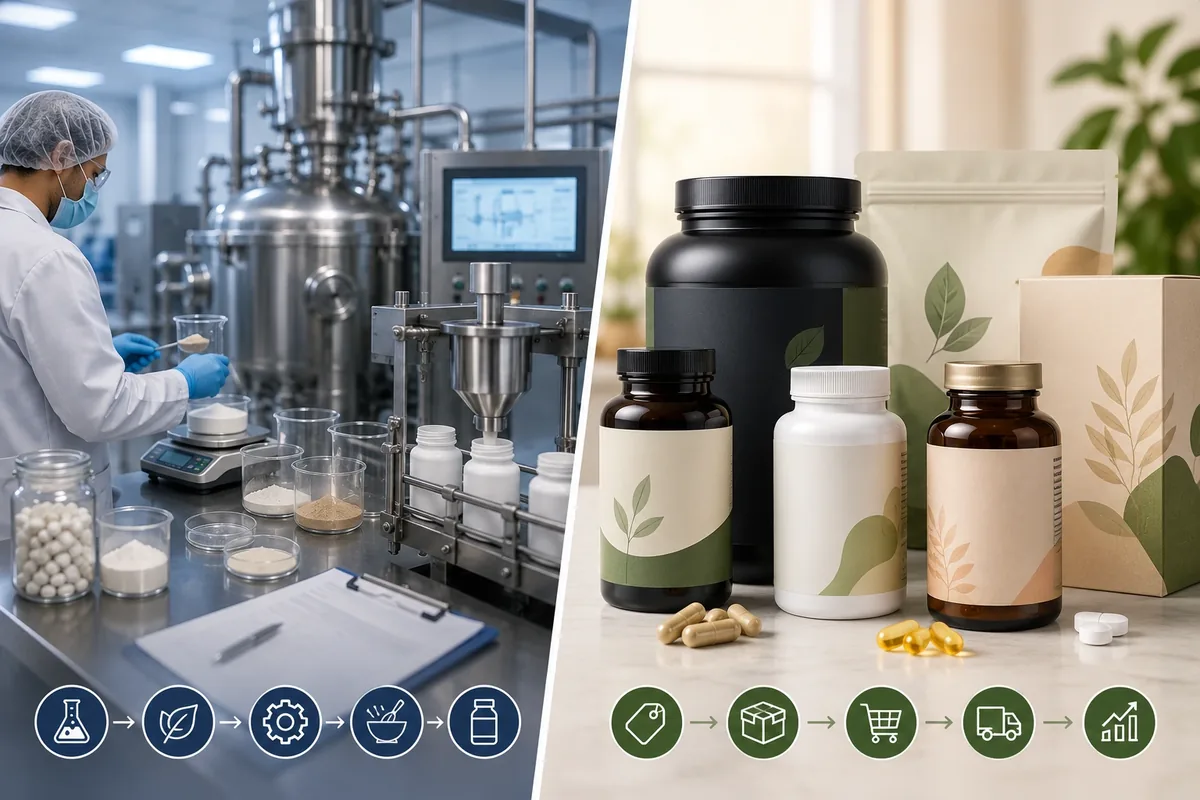
Table of Contents





Recent Posts
Popular posts
Certifications






Many supplement brands struggle not because of marketing, but because of what happens before the product ever reaches the shelf.
The choice between private label vs contract manufacturing sits at the center of that outcome. It determines how much control you have over your product, how fast you can move, and whether your brand can stand apart in a crowded category.
Both options can look similar. Both involve outsourcing production. Both allow you to bring a product to market without building a facility.
But the two models are different in how they affect control, speed, cost, and long-term brand value.
What is Contract Manufacturing in the Supplement Industry?
Contract manufacturing is a structured approach to building a supplement product around your brand’s requirements.
Instead of selecting an existing formula, the process begins with defining what the product should do, how it should be positioned, and which ingredients support that objective. From there, the manufacturer develops and produces the supplement accordingly.
Depending on the partner, this includes:
- Custom supplement formulation aligned with product positioning
- Ingredient sourcing based on quality, availability, and compliance
- Manufacturing under established GMP manufacturing protocols
- In-process and finished product quality control
- Packaging, labeling, and supply chain coordination
In a CDMO model, the scope extends further into R&D and regulatory support.
The defining feature of contract manufacturing is control. The brand defines the product. The manufacturer executes with technical and operational expertise.
What is Private Label Supplement Manufacturing?
To understand what is private label manufacturing, it helps to shift perspective.
In this model, the product already exists before the brand enters the process.
Manufacturers maintain a portfolio of ready-to-produce formulas. They are commonly referred to as stock formulations. These are standardized products that can be packaged and labeled for multiple brands.
The process is straightforward:
- Select a pre-developed formula.
- Choose packaging and labeling.
- Place a production order.
There is no formulation development phase. There is no change to ingredients or dosage structure.
Private label manufacturing is designed for speed. It reduces complexity but also limits control.
Contract Manufacturing vs Private Label: Key Differences
- Product Customization & Control
Contract manufacturing allows the product to be built from the ground up. Ingredient selection, dosage, and delivery format can be aligned with a specific use case or market segment.
Private labeling operates within predefined boundaries. The formulation is fixed. Any meaningful customization is not part of the model.
- Cost & Investment
Contract manufacturing requires a higher initial investment. It includes formulation work, sourcing, validation, and production setup.
Private label reduces upfront cost by removing development stages. The financial barrier to entry is lower, especially for early-stage brands.
- Time to Market
Contract manufacturing timelines are longer at the start. Development, testing, and production setup take time, particularly for new formulations.
Private label significantly compresses timelines. With formulas already in place, production can begin soon after order confirmation.
- Branding & Differentiation
Contract manufacturing supports differentiation at the product level. Unique formulations potentially create a defensible position in the market.
Private label limits differentiation to branding elements. The product itself may be identical to offerings from other brands.
- Scalability & Flexibility
Contract manufacturing is structured for scale. Production volumes can increase as demand grows. Adjustments to formulation or format can be introduced over time.
Private label is more rigid. Expansion depends on the manufacturer’s existing product portfolio and production capacity.
- Ownership & Intellectual Property
Contract manufacturing usually results in the brand owning the formulation, depending on the agreement. This becomes an asset for the brand over time.
Private label does not offer this advantage. The formulation belongs to the manufacturer. The continuity depends on their product availability.
Pros and Cons of Contract Manufacturing
Advantages
The advantages of contract manufacturing are closely tied to long-term brand building:
- Greater control over formulation and ingredient quality
- Access to technical expertise across formulation, compliance, and production
- Ability to innovate with new ingredients or delivery systems
- Alignment with regulatory frameworks under GMP manufacturing
- Capacity to scale production without reworking the product foundation
Disadvantages
There are also operational considerations that need to be accounted for:
- Higher upfront costs compared to pre-formulated products
- Longer initial timelines due to development and validation
- More complex coordination across sourcing, testing, and production
- Cost variability based on ingredient choices and supply conditions
Pros and Cons of Private Label Manufacturing
Advantages
Private label manufacturing simplifies market entry:
- Lower capital requirement to begin production
- Faster turnaround from concept to shelf
- Lower minimum order quantities in many cases
- Predictable pricing due to fixed formulations
Disadvantages
The simplicity of private label introduces structural limitations:
- Limited influence over ingredient selection or formulation changes
- Reduced access to formulation and regulatory expertise
- Difficulty establishing meaningful product differentiation
- Dependence on manufacturer-controlled product availability
- Lack of ownership over formulation and product identity
Which Option is Right for Your Brand?
The choice between private label manufacturing vs contract manufacturing depends on the stage and intent of the business.
Private label is often used when speed is critical and the goal is to test market response with minimal complexity.
Contract manufacturing becomes more relevant when the focus shifts toward building a differentiated product, maintaining quality consistency, and scaling with control.
Over time, the right choice usually depends on whether the priority is speed to market or stronger control over the product.
Key Factors to Consider Before Choosing
Before selecting a model, it is important to evaluate beyond cost and timelines:
- The level of control required over formulation and ingredient sourcing.
- The importance of differentiation within the target category.
- Expected production volumes over time.
- Regulatory expectations in the markets being served.
- Long-term brand positioning and product roadmap.
Making the Right Choice
The discussion around private label vs contract manufacturing is not simply operational. It is strategic. One approach prioritizes speed and simplicity, while the other focuses on customization, differentiation, and long-term scalability. The right choice depends on your brand goals, timeline, investment capacity, and level of product control required.
At F.A.M.E. Health Labs, we support brands through both models. Our private label program offers 450+ ready-to-label stock formulations from 500 units, helping brands enter the market faster. For brands that want greater differentiation, our contract manufacturing service develops custom formulations from 2,500 units, with label and packaging design support.
From formulation development to GMP-compliant manufacturing and commercialization, we help brands build and scale products aligned with their business vision.
Frequently Asked Questions (FAQs)
Q.1. What is the difference between contract manufacturing and private label?
Contract manufacturing involves developing a product via brand-specific requirements. Private label uses pre-existing formulas. They are repackaged under a brand name. The difference lies in control, customization, and ownership.
Q.2. Is contract manufacturing better than private label?
It depends on the objective. Contract manufacturing supports differentiation and long-term scalability. Private label supports faster entry with lower complexity.
Q.3. Which is more cost-effective: contract manufacturing vs private label?
Private label is more cost-effective at the start. This is due to lower development costs. Contract manufacturing may offer better value over time through product ownership and differentiation.
Q.4. How long does it take to launch a supplement product?
Private label products can be launched relatively quickly. This is because the formulas are already available. Contract manufacturing timelines depend on formulation complexity, testing requirements, and production scale. At F.A.M.E. Health Labs, stock runs under 30,000 units take 6 to 8 weeks after formula approval, and custom formulas take 8 to 12 weeks in total.
// Our Services
What Do You Need?
Select the service that matches your need. Each card expands to show what's included, minimum orders, and certifications then routes you directly to the right section of the form below.

F.A.M.E. Health Labs
Contract Manufacturing
Full-service supplement manufacturing from stock to custom white label, private label, co-manufacturing, and bulk.
See Services






F.A.M.E. Ingredients
Ingredient Sourcing
Global raw material sourcing, proprietary blend development, MOSA Organic, Halal and Kosher flavor systems.
See Services


Curí Inc.
Testing & CRO
ISO/IEC 17025 accredited testing ingredient and finished product. COAs accepted globally by FDA, Health Canada, and EU.
See Services

F.A.M.E. Complete
Enterprise Partnership
Full-platform commercial partnership for high-volume brands. Dedicated team, VP-level account management, real-time portal.
See Services